
Livestock General Rapid Test | Colloidal Gold Immunochromatography
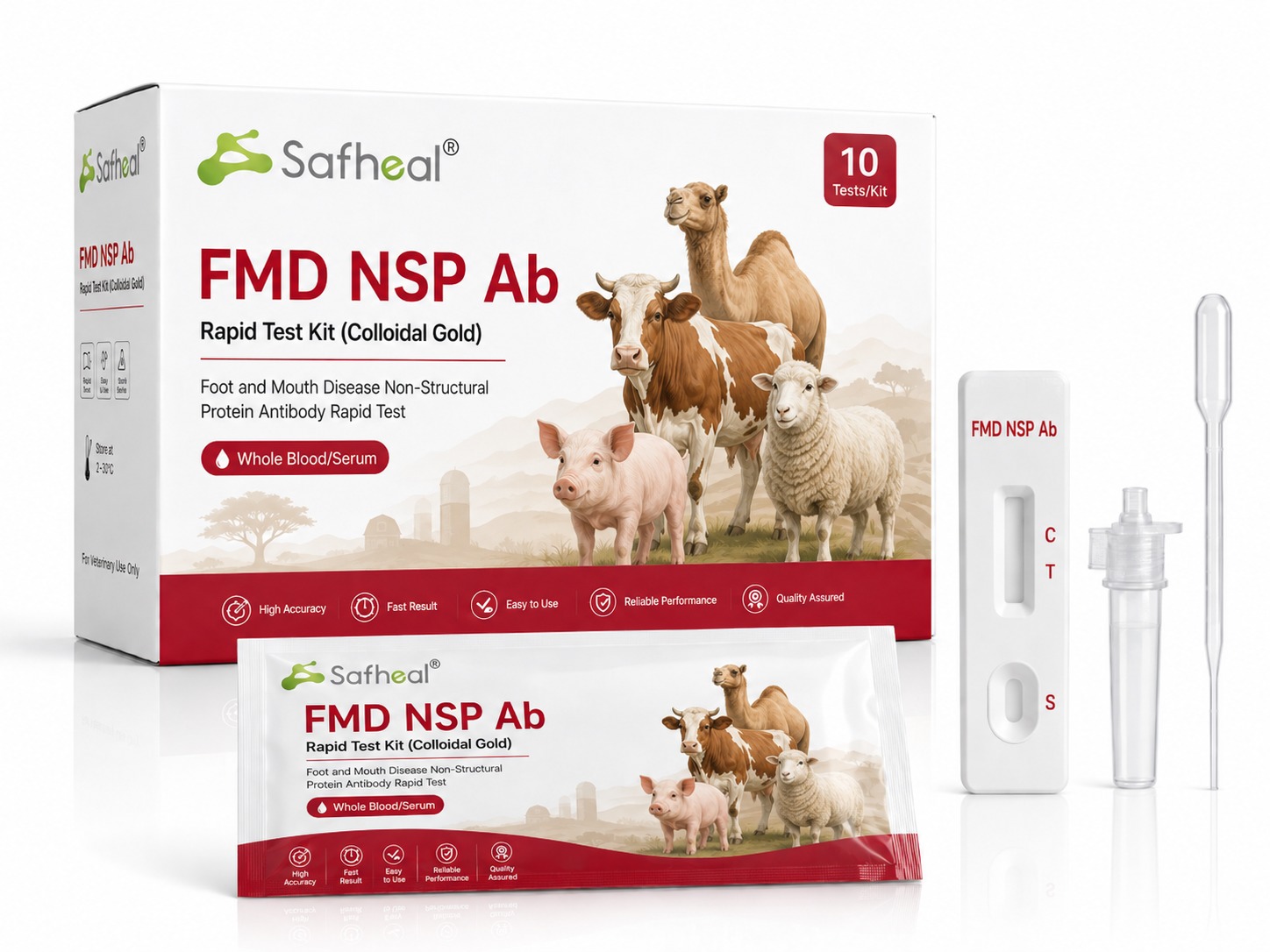
FMD NSP Ab Rapid Test Kit
For qualitative detection of FMDV NSP antibodies in animal whole blood or serum specimens to support livestock and veterinary laboratory screening.
Overview
Product Features
General screening for livestock and multi-species workflows
Covers antibody and antigen assays for farms, veterinary laboratories and field screening.
Rapid visual C/T line interpretation
No large analyzer is required for initial screening within the defined reading window.
Standard 10 Tests/Kit format
Consistent pack size supports distribution, inventory control and batch supply.
Assay-matched specimens
Supports whole blood, serum and feces workflows according to the target assay.
Professional Kit Configuration
Individually pouched cassette, sample buffer/tube, disposable sampling accessories and IFU.
Specifications
| Intended use | For qualitative detection of FMDV NSP antibodies in animal whole blood or serum specimens to support livestock and veterinary laboratory screening. |
|---|---|
| Method | Colloidal gold immunochromatography |
| Format | Rapid test cassette |
| Target analyte | Foot-and-mouth disease virus non-structural protein antibodies |
| Species | Cattle, swine, sheep and other IFU-covered livestock |
| Specimen | Whole blood or serum |
| Result time | 10 minutes |
| Storage | 2-30°C |
| Pack size | 10 Tests/Kit |
| Main components | Individually pouched cassette, sample buffer/tube, disposable sampling accessories and IFU |
| Use | Professional veterinary in vitro diagnostic use |
Testing Workflow
- 1 Collect the validated specimen and mix it with sample buffer as instructed in the IFU.
- 2 Apply the specified volume or drops of processed specimen to the cassette sample well.
- 3 Read the C/T line result within the defined interpretation window; do not interpret expired reads.
Note
This page is a product overview. Final specimen volume, procedure, registered intended use and performance data should follow the package insert and local regulatory requirements.